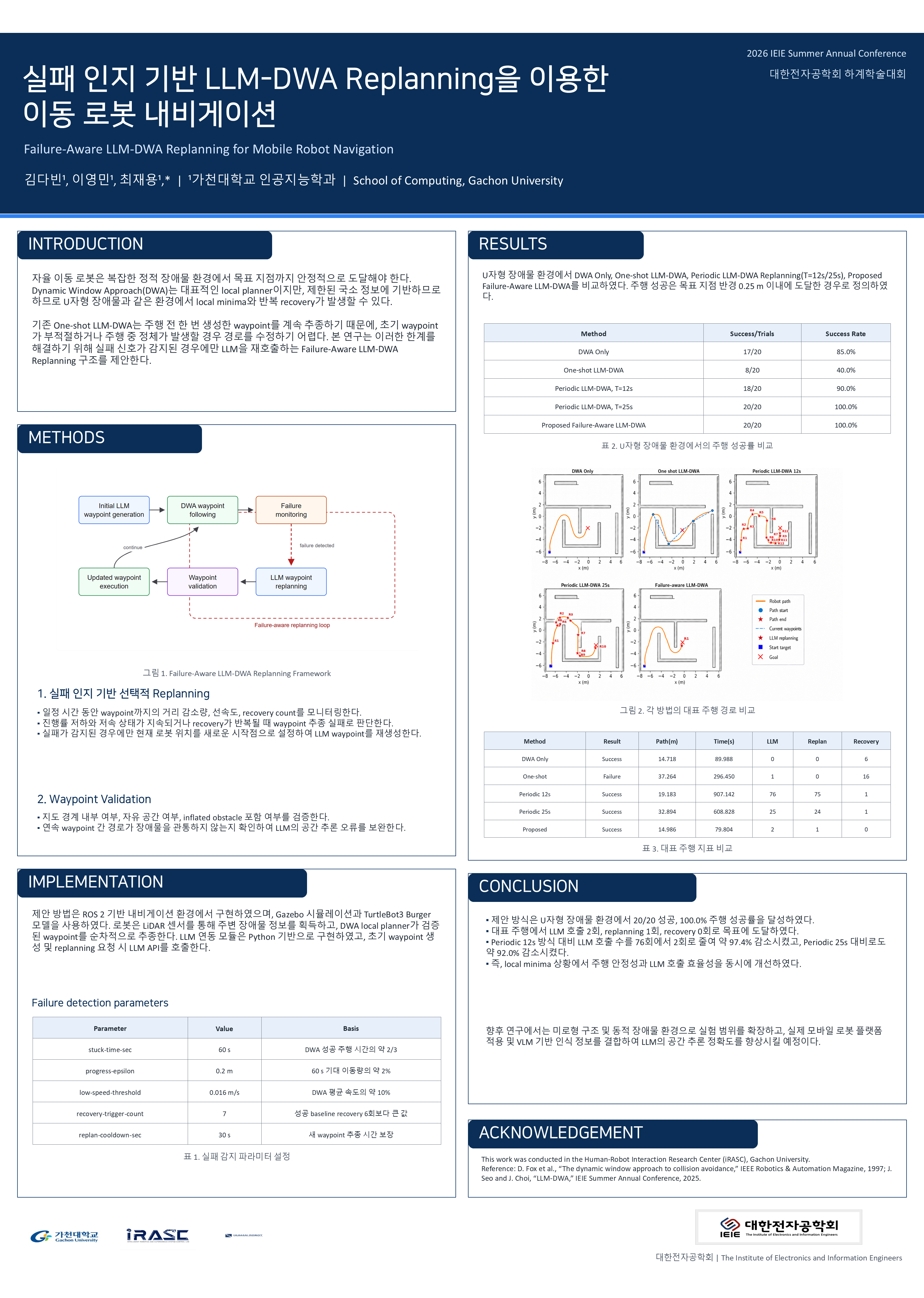
Failure-Aware LLM-DWA Replanning for Mobile Robot Navigation
Dabin Kim and Youngmin Lee are co-first authors.
Download paper PDFResearch summary
Failure-aware LLM-DWA achieved a 100% navigation success rate across 20 trials in a simulated static U-shaped obstacle environment.
It matched the best-performing periodic replanning baseline’s success rate while requiring fewer LLM calls in the representative runs reported in the paper.
My contribution
- Co-defined the research topic, extending prior LLM-DWA work with failure-aware replanning.
- Designed and conducted comparative experiments in a static obstacle environment, from initial setup through validation of the results.
- Defined and tuned the failure-detection signals, thresholds, and other key parameters of the proposed method.
Overview
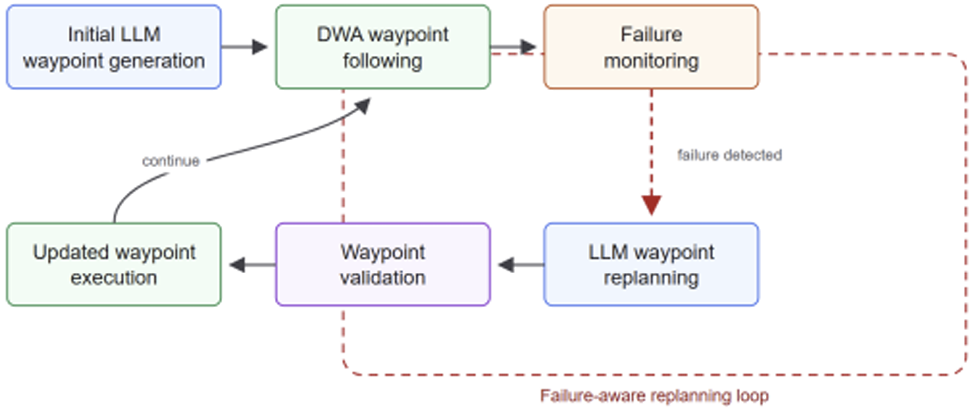
This study proposes failure-aware replanning for LLM-DWA navigation in complex static environments. The framework combines LLM-generated waypoints with DWA-based local planning and selectively requests new waypoints when the robot shows signs of navigation failure.
In a simulated U-shaped obstacle environment, the proposed method achieved a 100% success rate across 20 trials, matching the best periodic replanning baseline. Representative runs also demonstrated fewer LLM calls and recovery actions.
Motivation
DWA generates local motion commands while respecting the robot’s velocity and acceleration constraints. Its limited local perspective, however, can make it vulnerable to local minima around obstacles such as U-shaped structures.
LLM-generated waypoints provide higher-level route guidance, but one-shot LLM-DWA cannot revise its initial waypoints during navigation. If those waypoints are poorly placed or the robot becomes stuck, the local planner may continue following an ineffective route.
This study addresses that limitation through selective replanning and waypoint validation.
Failure-Aware Replanning
The system monitors progress toward the current waypoint, linear velocity, and the number of Nav2 recovery actions. Replanning is triggered when insufficient progress and low velocity persist, or when recovery actions occur repeatedly.
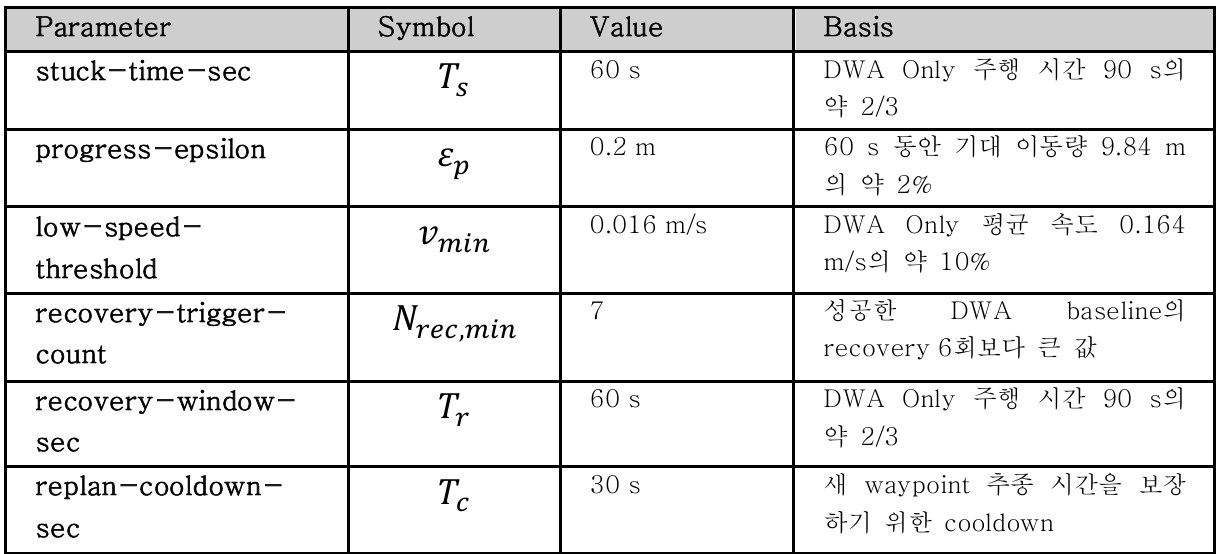
The failure monitor uses a 60-second progress window, a minimum distance reduction of 0.2 m, and a low-speed threshold of 0.016 m/s. The recovery trigger is seven actions within 60 seconds. A 30-second replanning cooldown gives the robot time to follow newly generated waypoints.
These parameters were conservatively selected using a representative successful DWA-only run to reduce unnecessary replanning caused by temporary slowdowns.
When failure is detected, the robot’s current pose becomes the new starting point for waypoint generation. The LLM receives the current pose, goal, current waypoint, and failure information, and returns an updated waypoint sequence in JSON format.
Waypoint Validation
Generated waypoints are checked before being passed to the navigation system. Each waypoint must lie within the map boundaries and in free space outside obstacles inflated to account for the robot’s radius and a safety margin.
Connections between consecutive waypoints are also checked by sampling grid cells to identify obstacle intersections.
Invalid waypoints are removed, or a new sequence is requested from the LLM when necessary. This validation addresses spatial errors in LLM-generated waypoints before execution.
Experimental Setup
The system was implemented in ROS 2 and Gazebo using a TurtleBot3 Burger model with LiDAR sensing and a DWA-based local planner. The LLM integration module was implemented in Python.
Five configurations were evaluated in a static U-shaped obstacle environment: DWA only, one-shot LLM-DWA, periodic LLM-DWA replanning at 12-second and 25-second intervals, and the proposed failure-aware method.
Each configuration was evaluated over 20 trials with the same start and goal positions. A trial was considered successful when the robot reached within 0.25 m of the goal.
Evaluation metrics included navigation success rate, path length, navigation time, recovery count, LLM call count, and replanning count.
Results
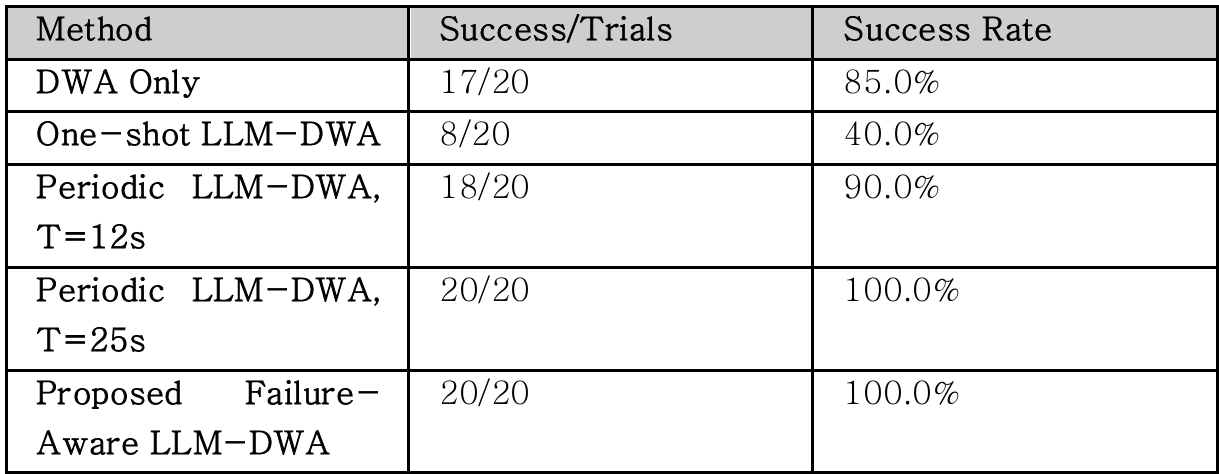
The proposed method succeeded in all 20 trials. The 25-second periodic baseline also achieved 20/20 successes, followed by the 12-second periodic baseline at 18/20, DWA only at 17/20, and one-shot LLM-DWA at 8/20.
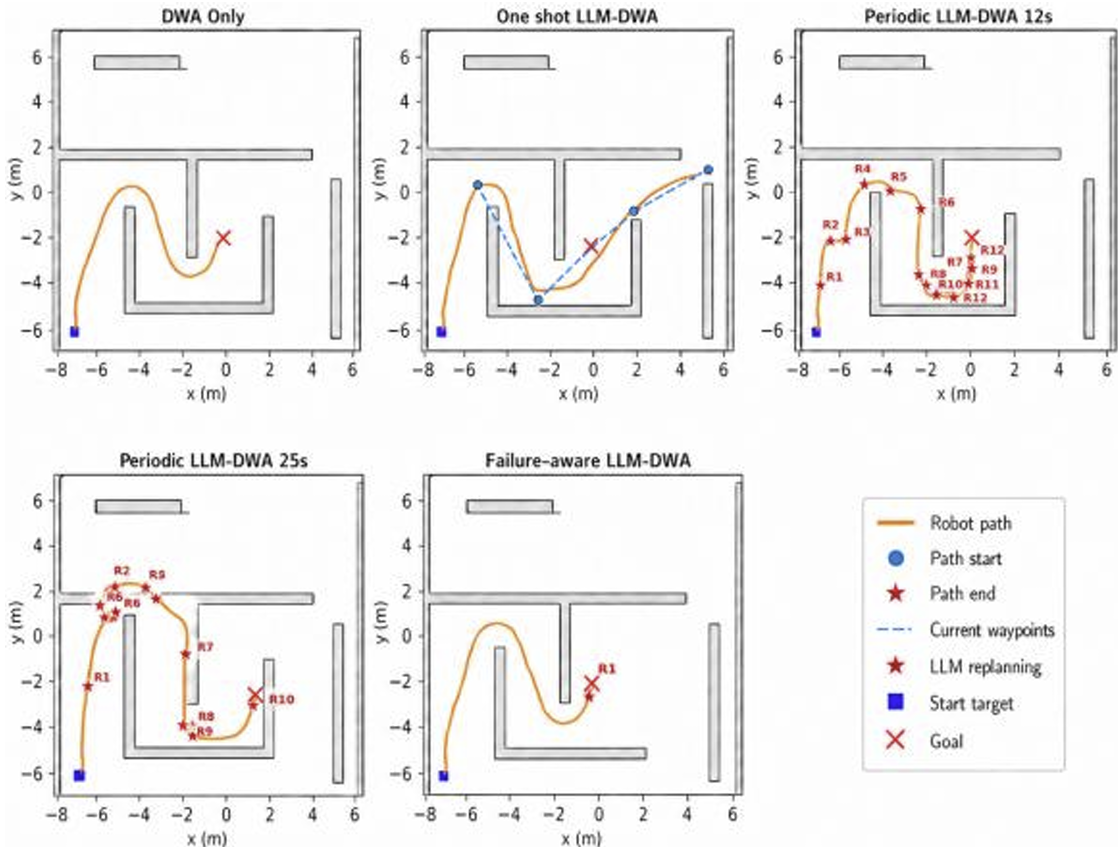
In the representative run reported in the paper, the proposed method reached the goal with two LLM calls, one replan, and no Nav2 recovery actions. Its path length was 14.986 m, and its navigation time was 79.804 s.
The representative periodic runs required 76 LLM calls at the 12-second interval and 25 calls at the 25-second interval.
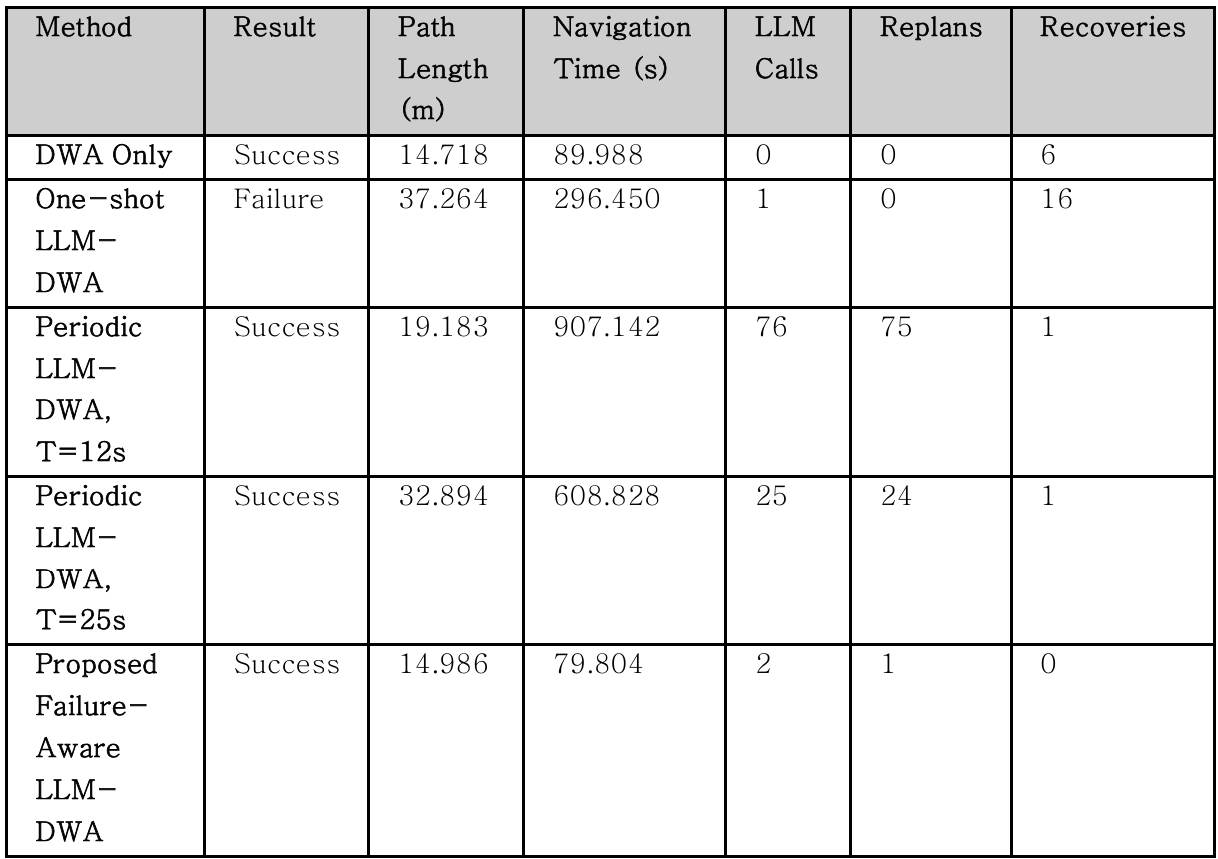
These results support failure-triggered replanning as an effective way to maintain navigation success while reducing unnecessary LLM calls in the evaluated setting.
Success rates reflect all 20 trials per configuration; the remaining metrics describe representative runs rather than trial averages.
Scope and Future Work
The evaluation covers a simulated static U-shaped obstacle environment. Dynamic obstacles and physical robot experiments remain future work.
Planned extensions include more complex static environments such as mazes, dynamic obstacle scenarios, and deployment on a physical mobile robot to examine differences between simulation and real-world performance.
The paper also proposes incorporating structured map information or VLM-based perception to improve the LLM’s spatial reasoning.
Posters & event photos